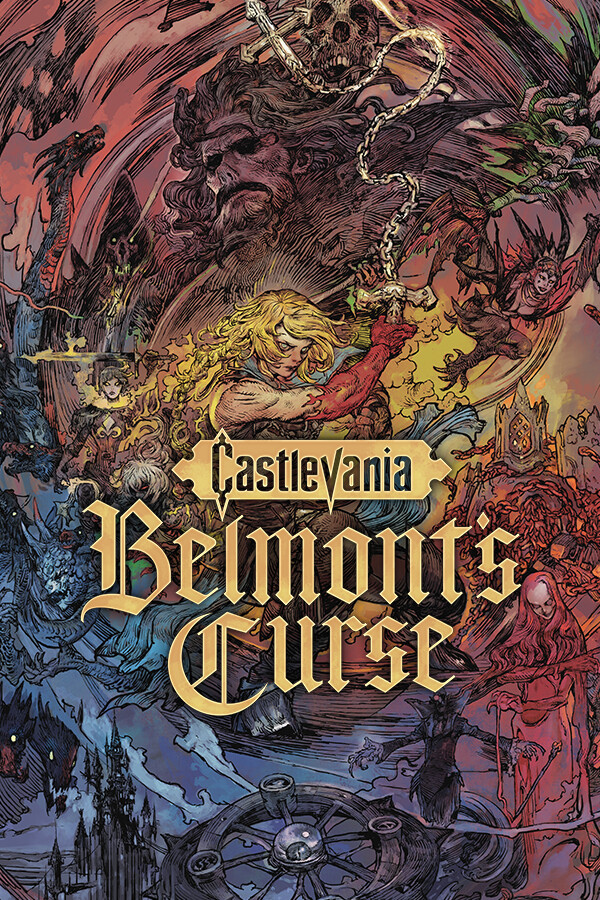
Castlevania: Belmont's Curse - Review
Does the curse on the series finally lift?
I was a tiny kid when I first played the original Castlevania on a Famiclone console. Even those 8-bit monsters scared the living daylights out of me back then. I never managed to finish the game, but I did make quite a bit of progress. Then I got my hands on a cartridge of the second game, Simon’s Quest. One of the ancestors of the Metroidvania genre, it had an incredible atmosphere and fantastic music, but its gameplay was notoriously cryptic. Determined to make progress, I grabbed an English-Turkish dictionary and started translating sentences word by word, trying to make sense of them. To this day, it remains one of the games that inspired me to learn English.
After Simon’s Quest, I lost touch with the series. That is, until the legendary Symphony of the Night came along during the PS1 era. My God, what an incredible game! I still consider it one of the greatest games ever made. SotN turned me into a Castlevania fan, and I began working my way through every game in the series, one by one. I still own most of them in their original versions as part of my collection.

The Metroidvania games that followed SotN were also excellent. Unfortunately, the series struggled to make the transition to 3D. The Nintendo 64 entries were, at best, games you could describe as "not bad, I suppose." The action-oriented titles released during the PS2 era were good, too, but they fell short of contemporaries like God of War. Then came the PS3 era, and Lords of Shadow got off to a great start, especially thanks to its surprise ending. Its sequel, however, completely derailed things, sending us into battle against robots and even having us sneak past enemies as a rat. As other Metroidvania games also began to feel increasingly repetitive, Castlevania gradually faded from the spotlight and disappeared into a silence that would last for quite some time.
We've certainly been using this expression a lot lately, but with Konami bringing back its classic franchises one after another, from Contra and Suikoden to Metal Gear and Silent Hill, it's finally Castlevania's turn. Belmont's Curse is the first mainline Castlevania game in 12 years, provided we don't count all those bizarre crossovers, mobile and browser games, and compilation releases in the meantime. As you can imagine, that makes it a game carrying some pretty hefty expectations for someone like me, who's been following the series for more than 30 years.


This One's for My Mother Sypha! This One's for My Father Trevor! And This One's for the People of Paris!
Belmont's Curse takes place in 1499, 23 years after the events of the third game, Dracula's Curse. As monsters overrun Paris and the death toll continues to rise, our legendary vampire hunter Trevor Belmont (and yes, Trevor really is referred to as a legendary Belmont in the series) arrives in the city with his daughter, Rose, to investigate. I should also mention that Trevor's wife, the sorceress Sypha, whom we also know from the third game, died while giving birth to Rose. When Trevor leaves us to meet with the bishop, control passes to Rose, and we begin exploring the streets of Paris before inevitably wandering through Dracula's castle for what must be the umpteenth time. I'll leave the story there to avoid spoilers, but I will say that you'll encounter some surprising characters from the series along the way. In fact, hearing one of them voiced by the same actor after all these years (I never forget a voice performance) left me absolutely delighted and genuinely stunned. Anyway, I'll shut up now.
The first thing you'll notice is just how much the game draws from Netflix's Castlevania animated series, assuming you've watched it. The latest series, Nocturne, also takes place in France. Both the character designs and the environments bear a striking resemblance to their animated counterparts. The environments, in particular, are beautifully illustrated and packed with detail. Burning buildings, corpses, skeletons, and all sorts of gruesome sights do a great job of conveying the horror unfolding throughout the city. I also found the soundtrack surprisingly reminiscent of the King's Field series, thanks to its synthesizer-heavy sound and gothic motifs. The music differs considerably from Michiru Yamane's compositions, but I think it suits the game perfectly and works wonderfully in its own right. There are also arrangements of classic tracks from the series, including Bloody Tears.

In my opinion, Belmont's Curse returns to the genre that suits Castlevania best: Metroidvania. That said, it also takes a few turns towards the Soulsvania subgenre. Traditional RPG elements such as item usage, shopping, and detailed skill-point systems have been replaced by mechanics more reminiscent of the Souls games. You use crystals much like Estus Flasks, respawn at your last checkpoint instead of getting a traditional Game Over when you die, and enemies respawn whenever you save. Parrying also plays a significant role. You still level up, but the only stats that increase are your attack and defense. There aren't any other attributes to invest in, such as luck or speed.
I'm Gonna Ride Dracula and Whip Him Good!
Based on the footage I'd seen before release, I mentioned in my preview that the whip-swinging mechanic from Castlevania IV, which lets you latch onto things and swing around, was making a comeback. It turns out I seriously underestimated just how important it would be. I'm not exaggerating when I say that this mechanic accounts for nearly 90% of the game. I expected it to be a minor addition, but instead, it's something you'll need to use actively throughout almost every platforming section and even during combat. You'll need to master it, too. You can latch onto enemies and pull yourself towards them, navigate trap-filled obstacle courses straight out of Prince of Persia, and activate mechanisms. In Belmont's Curse, your whip is practically everything.


Speaking of Prince of Persia, the game features plenty of trap-filled platforming sections similar to those in The Lost Crown. Yes, previous Castlevania games had platforming challenges, but Belmont's Curse takes them to a whole new level. Combine the whip-swinging mechanic with abilities like dashing and temporarily destroying objects with Holy Light, and you get obstacle courses that require you to chain these abilities together, much like in The Lost Crown. Some of them can be downright maddening. Honestly, I suspect the developers took a few cues from The Lost Crown when designing these sections. Still, I can't deny that I enjoyed most of them.
Combat offers a variety of weapons with distinct playstyles, ranging from spears and dual swords to daggers and halberds. Spears, for instance, can be thrown whenever you want (I managed to take down the Medusa boss without too much trouble this way). A sword and shield let you defend yourself at any time, while dual daggers increase your damage as you build up your combo count. Personally, the halberds suited my playstyle best. They're slow, but they deal heavy damage and have an impressive reach. Still, I'd recommend giving every new weapon type a try when you find one. As I mentioned earlier, there's no shop system, so you'll have to explore the map to discover new weapons.


Since we're on the subject, I want to emphasize that exploration is easily the game's greatest strength. I've played through the entire series, and I can't think of another entry with quite so many hidden rooms, weapons, upgrades, and items waiting to be discovered. Break every suspicious wall, try sliding beneath every gap, and even experiment with touching the ceiling while swinging from your whip to uncover fake ceilings. Practically every corner hides a secret. I'm not exaggerating when I say I occasionally stumbled across hidden discoveries entirely by accident while fighting enemies. I absolutely loved that sense of exploration. Your HP and mana also don't increase automatically as you level up; instead, you'll need to find individual heart pieces scattered throughout the map.
Getting back to weapons, the secondary weapons that have become a staple of the series are also present. Many of these are obtained from supporting characters, including Medusa's petrification ability, Carmilla's blood blades, and The Fallen's throwable cross. You can upgrade these secondary weapons by completing specific challenges, too. These range from "Kill five monsters with a single cross" and "Parry 15 times" to occasionally rather unrelated objectives, such as "Find the location of *****." Each completed challenge rewards you with points that can be spent on whichever attribute of a secondary weapon you want to improve. You might unlock the ability to throw two crosses at once or reduce the mana cost of your fireballs, for example. With the variety of secondary weapons added to the already diverse selection of primary weapons, the game offers some nice customization options that let players develop their own playstyles.

The Fallen? Yeah, Bro, Fallen Is My Favorite Evanescence Album Too
Unfortunately, the boss fights are merely okay. Rather than encouraging players to find their own solutions, most encounters revolve around learning and memorizing attack patterns, which isn't a design choice I particularly appreciate. I can't say I've experienced any truly memorable boss fights, either.
There are also one or two things that bothered me during the game's action sequences. First, there's so much flashing light and so many animation effects that it can become impossible to tell what's going on, especially during fights against large groups of enemies. My wife watched me play for most of the game, and every now and then she'd say, "I have no idea what's happening on screen right now." The problem was that I usually felt the same way. When things got too chaotic, I'd resort to my standard combo and just hope for the best: use a secondary weapon, latch onto the most troublesome enemy with the whip, pull myself towards them (which grants a few brief moments of invulnerability), land a few hits, parry once I hit the ground, and repeat. The other problem is that some fights feature enemies who spam projectiles so relentlessly that, eventually, there's nowhere left to move. I genuinely started wondering whether the game was trolling me just to get on my nerves.
Before I forget, there's another new feature worth mentioning: tarot cards. These cards were inherited by Rose from her mother, Sypha, and you gradually fill them with information about the major enemies they represent. For example, you might encounter a ghost that gives you a clue about Medusa's location or the solution to a puzzle. You can then consult the relevant card whenever you need that information. The abilities you acquire from defeating bosses are also stored on these cards as Arcana. Essentially, they're a glorified notebook, albeit one with a little more flair.

We've covered the game's strengths and new features, from exploration and trap-filled platforming to weapon combinations and music. Now it's time to talk about the downsides. First, I wasn't particularly fond of the map's layout when it comes to getting around. Although some fast-travel points become available as you progress, there aren't many of them, and they're spread so far apart that travelling from one area to another can take quite a while. (I'll make an exception for the Clock Tower, with its elevators.) In games like Bloodstained and Hollow Knight, however, the maps were designed so cleverly that seemingly unrelated areas could suddenly connect, allowing you to travel from one end to the other in no time. As a result, backtracking never felt like such a chore. There were moments when I'd unlock a new platforming ability and realize I could finally reach an area I'd previously been unable to access, only to think, "Ugh, who's going all the way over there now?" No matter how large a Metroidvania's map is, making previously visited areas easy to revisit is one of the genre's most fundamental requirements.
I also mentioned the one or two things that bothered me during combat. On top of those issues, enemies in newly discovered areas have far more health than they should, much like in Order of Ecclesia. You can keep hitting them, but they just refuse to die. Naturally, they become easier to kill as you level up, but having to beat enemies like they're bullet sponges until then isn't much fun. Enemies should challenge you with their attack patterns and keep you on your toes, not by having seemingly endless health bars. Hollow Knight, for instance, handled this brilliantly. Even the weakest enemy could kill you with ease, but once you'd learned its patterns, you could take it down just as easily. I also have no idea why endlessly spawning enemies like Ghost Heads, Medusa Heads, and even those pathetic little bats deal so much damage. Having these tiny nuisances hit like a truck while you're already struggling to make sense of all the visual effects on screen feels downright unfair. Don't get me wrong, I wouldn't say the game is excessively difficult overall, but these are the kinds of things that shouldn't be getting on your nerves.


To be completely honest, the first few hours of Belmont's Curse had me worried. Rose felt far too sluggish for an action game, backtracking was a pain, and enemies seemed practically immortal. But as I progressed, unlocked new abilities that made the character more dynamic and versatile, and started getting more out of the exploration, I began to enjoy myself. That said, games like Hollow Knight, Blasphemous, and The Lost Crown have raised the bar for the genre so high that it would be difficult to call Belmont's Curse an outstanding game while those titles exist. If you ask me, even Bloodstained, which lacks the Castlevania name but carries on its legacy, was a slightly better game (and the original Curse of the Moon was absolutely fantastic).
It's hard to explain this without sounding overly critical, but Belmont's Curse is definitely a good and enjoyable game. It's more than adequate as the comeback of a long-dormant franchise. But does it offer anything truly groundbreaking or have what it takes to reach the very top of its genre? No. It's simply a good Metroidvania, nothing more. I spent a long time debating whether to give it a 7.5 or an 8, but I think I'll settle on a 7.5. Even so, I'm personally glad that such a long-running series has chosen to stay true to its roots rather than becoming unrecognizable in the name of modernization through a bunch of ridiculous gimmicks. I have a feeling the next entry will be even better.
© Konami Digital Entertainment
Başlıklar
SON KARAR
Belmont’s Curse is a solid enough return for such a long-running series after such a lengthy absence, and it becomes an enjoyable experience if you give it some time. However, with no new ideas to bring to the genre, it never manages to be more than a good Metroidvania.
Castlevania: Belmont's Curse
İyi
7.5
Artılar
- The sense of exploration is fantastic, with secrets hidden around every corner.
- You can create weapon combinations that suit your playstyle using primary and secondary weapons.
- It's great to see some familiar characters from the series return as surprises.
- The atmosphere and soundtrack are excellent.
Eksiler
- It doesn't bring anything new to the genre.
- The overall map design is poor, making backtracking a chore.
- During crowded fights, it can sometimes become impossible to tell what's going on.
- I would have preferred a shop system.