Psycho-Sleuth - Review
You Can't Even Trust Yourself These Days…
You know one of the best things about playing mystery and detective games? Slowly piecing together the answers the game is desperately trying to keep hidden from you. Connecting the dots, coming up with your own theories, and suddenly realizing the significance of a clue that seemed completely meaningless a moment ago, making you go, "WAIT A MINUTE, SO THAT MEANS THIS TOO!" It's not something I get to experience very often in other genres. Perhaps the closest thing would be jumping into a Destiny raid without knowing anything and figuring out its mechanics entirely on my own. While playing Psycho-Sleuth, this inevitably became one of my main points of focus: Does the game actually give me those feelings I just described, or is it experiencing them on my behalf?

WE'VE BEEN SET UP…
Psycho-Sleuth managed to grab my attention with its premise alone. The game takes place in a world where cognitive disorders can be harnessed as "superpowers" known as Pathosync. These include prosopagnosia (face blindness), obsessive-compulsive disorder (which manifests as an inability to lie in the game), synesthesia (which extends to all five senses here), and many more. I'm sure you can imagine how these conditions might be used as superpowers. Face blindness can be spread to everyone around you, while synesthesia allows you to "create worlds," for example. Now imagine 13 people with these abilities being invited by an organization called the Church of Logic to participate in an actual game of "Werewolf," where the winner is promised godhood. Naturally, they can also use their powers to kill one another. I don't think I need to explain just how messy things can get.
The game's central objective is to survive these rounds of Werewolf and figure out who killed whom, and how, whenever someone turns up dead. Get the answer right, and you move on to the next round. Get it wrong, and the Werewolf wins, earning the promised godhood in the process. Beyond these individual "whodunit" mysteries, the game also presents much bigger questions that affect the overarching story: "What is the Church of Logic really after?", "Why did the High Priest join this event?", and "Wait a minute, who actually is the High Priest?" You inevitably find yourself turning these questions over in your head throughout the game, constantly looking for clues.


The writing is particularly impressive in this regard. None of the murders leave you thinking, "Holy crap, how are we supposed to solve this?" or "Whoa, where the hell did that come from?" Once you pay attention to the game's rules, powers, and internal logic, everything is explained in a satisfying way, including its biggest mysteries. I honestly can't remember a single moment when I thought, "Come on, isn't this stretching things a bit?" This might sound like a strange thing to praise, but I've encountered so many ridiculous plot developments lately that I genuinely appreciate a game that manages to avoid them.
And to be honest, it's not just the mysteries and murders. The overall writing is excellent. The game knows when to be serious and when to get emotional (the third chapter absolutely destroyed me), and it never takes its humor too far. The characters feel believable and are easy to connect with, while their backgrounds and the circumstances that brought them to where they are now are explained beautifully. It's been a long time since I've played a game with such a large cast without thinking, "Ugh, what a pointless, incompetent character." There were certainly moments when I had mixed feelings about some of them, but by the end of my 30-hour playthrough, every single one had found their place in the puzzle.
One of my favorite aspects of the game's storytelling is how it throws an "unreliable narrator" at you right from the very first chapter. And don't worry, it doesn't exactly hide this fact or make it easy to miss, so don't take this as a spoiler. Our protagonist, Lyle, experiences his Pathosync through synesthesia, which can cause his powers to spiral out of control and make it difficult for him to distinguish what's real from what's not. Even when the game isn't actively trying to mess with you, this naturally plants a little voice in the back of your mind asking, "Okay, this is all well and good, but are we actually seeing things correctly?" That's a fantastic trick for a mystery and detective game.


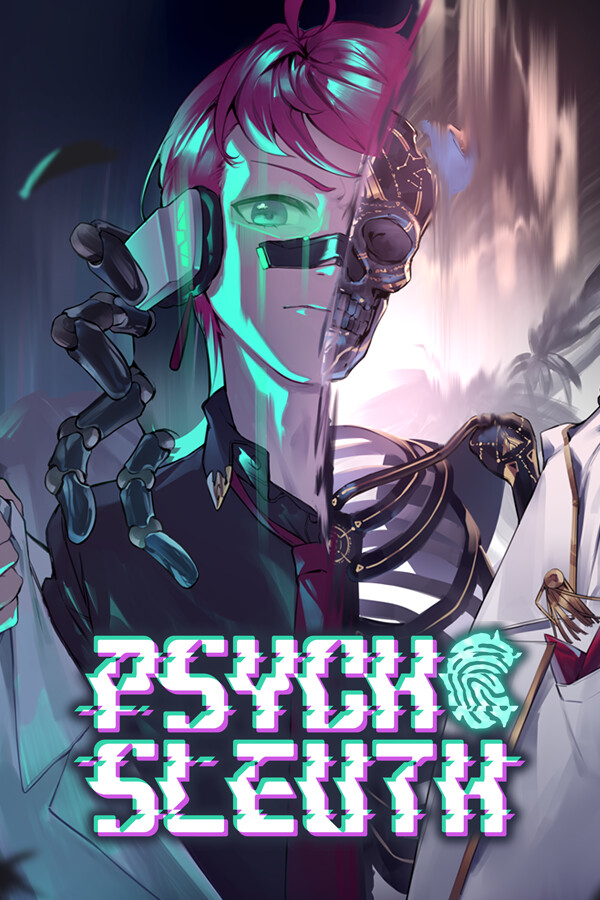
The character designs also play a big part in why I found the storytelling so effective. The anime-style character models, animated using Live2D (a technology commonly used for VTuber avatars), are memorable and full of personality. The background artwork, anime-style cutscenes reminiscent of Persona, CG sequences, use of blood and gore, and voice acting all do a great job of reinforcing both the characters and the game's overall atmosphere. I will admit that the characters' mouths not moving despite the use of Live2D was a little distracting, but considering that the game was developed by a team of just five people, I'm willing to let that one slide. Unfortunately, there are other issues I can't be quite as forgiving about.
…BUT IS THE GAME PLAYING ITSELF?
One of the first things that caught my attention was the user interface, and not necessarily in a good way. It's not terribly frustrating or particularly annoying, although I did run into a few issues where mouse clicks wouldn't register. I'll chalk those up to the fact that I was playing an early build, especially since the game was receiving constant 2-3 GB updates almost every day I played. My main issue is that the interface feels a little too simplistic and cheap. I know I just mentioned that the game was made by a five-person team, and I'm certainly not expecting an "Atlus-style UI" or anything like that. Still, I couldn't shake the feeling that it looked cheap compared to the quality of the game's other visual elements. That's a particularly important shortcoming for a genre like visual novels, where the interface is such an integral part of the overall experience.

My other major issue is the lack of interaction. Despite its excellent writing, Psycho-Sleuth's limited interactivity makes it feel as though the developers don't entirely trust players to figure out their planned murders or larger mysteries on their own. Here's what I mean: the game doesn't actually let you freely explore the Werewolf game venue. Scenes play out, events unfold, you collect clues at certain points, a murder takes place, you gather more clues, watch some more scenes, and eventually move on to the discussion phase. You rarely get the option to revisit previously explored areas or investigate your surroundings more thoroughly. The game simply tells you, "And then we all went over there," and moves on to the next scene. You don't even have to worry about missing clues. Once you've collected everything in an area, the game automatically advances to the next scene.
The discussion and trial sections try to introduce more interaction, but even here, the game insists on holding your hand. Trials follow a familiar loop: characters begin discussing the murder, and whenever someone presents an idea, the game transitions into an "Interactive Debate Battle." During these battles, you have 120 seconds to challenge an opponent's conclusion using the correct piece of evidence. Every wrong answer costs you 50 HP out of your 2,000, meaning you can afford 40 mistakes per chapter.


There are two things that particularly bothered me here. First, the game insists that you use the correct piece of evidence against one very specific statement, even when there are other perfectly valid arguments you could make. This is usually what caused me to lose HP. The dialogue leading up to these "debate battles" practically spells out what's wrong with the opponent's argument. And once you counter it with the correct evidence, the characters explain why you're right through more dialogue. You barely have to do anything yourself. As a result, I never even came close to running out of HP, because you'd have to go out of your way to keep giving wrong answers. I actually decided to try it once just to see what would happen, and all I got was a very basic "GAME OVER" screen popping up out of nowhere. That's it. I guess even the developers didn't expect anyone to reach that point.
At the end of each trial, the "Case Summary" section asks you to reconstruct the events by placing comic panels in the correct order. But once again, the game holds your hand. Let's say there are 12 panels. The game has already placed six or seven of them for you (hehe), then asks you a series of questions to fill in the remaining gaps. Once you're done, another cutscene plays in which a character narrates the entire summary. They could have made this considerably more interactive by asking us to arrange the panels while the character was recounting the events, for instance.
In short, Psycho-Sleuth's biggest problem is that it fails to translate its tense atmosphere into its gameplay. There's supposedly a constant sense of "risk," but in practice, there really isn't any. You have an HP bar, but being allowed 40 wrong answers makes it practically meaningless. There's a time limit, but running out of time only costs you 50 HP before you get to try again. You can make choices, but aside from a handful of answers that lead to "Bad Endings," you don't really have much freedom. The fact that there are no difficulty settings beyond Easy and Normal, or any options that would let you make the experience more challenging for yourself, only adds to the problem. Put all of this together, and it's hard not to feel a disconnect between the quality of the writing and the actual gameplay.
LOVED IT, WON'T LIE

Interestingly enough, despite all these shortcomings, I walked away from Psycho-Sleuth feeling genuinely satisfied. At the end of the day, it's a game that tells the story it wants to tell successfully and sends you off with a satisfying conclusion. I was impressed by almost everything, from its music and visuals to its characters and mysteries. The reason I've been so hung up on its flaws is probably that I can see the missed potential. Both the game and its development team have plenty of it, and these aren't issues that can't be addressed in their next project.
With a bigger budget, they could deliver a much more interactive experience. They just need to trust their players a little more. Let us make mistakes. Let us explore areas in search of clues. Give our wrong answers meaningful consequences. These are the kinds of things that can take a game in this genre to the next level. I'm already looking forward to seeing what the team comes up with next.
This is an AI translated version of the original Turkish review which can be found here.
Başlıklar
SON KARAR
Psycho-Sleuth tells a genuinely compelling story with genuinely compelling characters. I only wish its gameplay were as engaging as its story and characters.
Psycho-Sleuth
İyi
7.5
Artılar
- The overall concept is intriguing.
- The character designs are appealing and memorable.
- Both the story and character writing are excellent.
- "Pathosync" adds an extra layer to the experience and is handled very well.
- The puzzles are fair.
Eksiler
- ...but it all feels a little too simplistic.
- There's very little player interaction, and the gameplay rarely offers any real challenge.
- The UI feels a bit cheap.